RIFT: Entropy–Optimised Fractional Wavelet Constellations for Ideal Time–Frequency Estimation
We introduce a new method for estimating the Ideal Time-Frequency Representation (ITFR) of complex nonstationary signals. The Reconstructive Ideal Fractional Transform (RIFT) computes a constellation of Continuous Fractional Wavelet Transforms (CFWTs) aligned to different local time–frequency curvatures. This constellation is combined into a single optimised time-frequency energy representation via a localised entropy-based sparsity measure, designed to resolve auto-terms and attenuate cross-terms. Finally, a positivity-constrained Lucy–Richardson deconvolution with total-variation regularisation is applied to estimate the ITFR, achieving auto-term resolution comparable to that of the Wigner–Ville Distribution (WVD), yielding the high-resolution RIFT representation. The required Cohen's class convolutional kernels are fully derived in the paper for the chosen CFWT constellations. Additionally, the optimisation yields an Instantaneous Phase Direction (IPD) field, which allows the localised curvature in speech or music extracts to be visualised and utilised within a Kalman tracking scheme, enabling the extraction of signal component trajectories and the construction of the Spline-RIFT variant. Evaluation on synthetic and real-world signals demonstrates the algorithm's ability to effectively suppress cross-terms and achieve superior time-frequency precision relative to competing methods. This advance holds significant potential for a wide range of applications requiring high-resolution cross-term-free time-frequency analysis.
Accompanying Visuals
An interactive visualisation of the derived Cohen’s class constellation in the time-frequency plane, available here
A visualisation of the proposed parametric Continuous Fractional Wavelet Transform (CFWT) for varying angles in the time-frequency plane for a pair of sinusoidally frequency-modulated sinusoids. The cross terms are eliminated in cases where the wavelet angle aligns with the local signal's instantaneous frequency. The wavelet’s corresponding Cohen’s class kernel is shown in the top right-hand corner
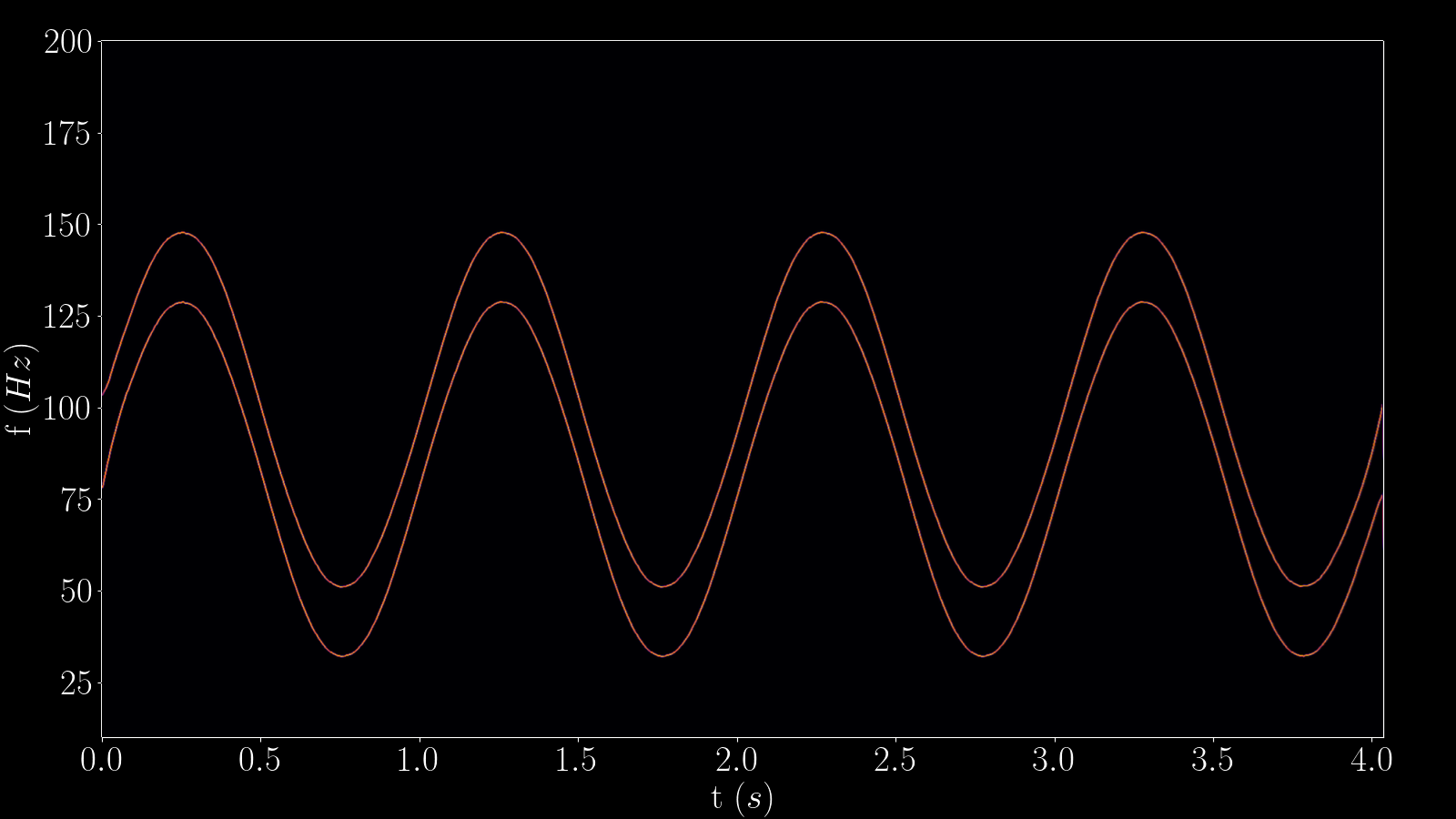
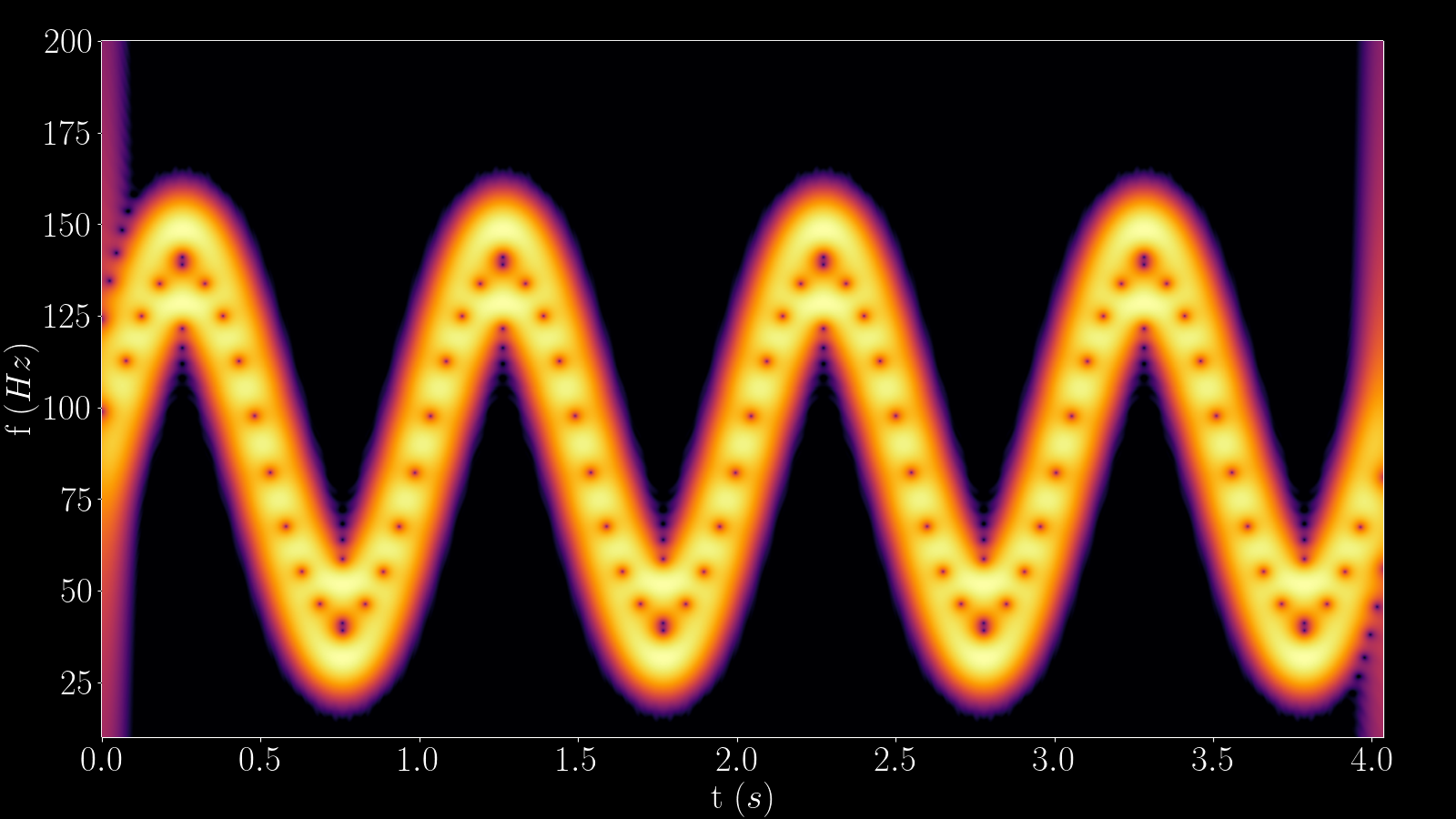
A visualisation of the proposed Spline-RIFT algorithm. Shown is a reference Continuous Wavelet Transform (CWT) with an isometric Gaussian Cohen’s class kernel for a pair of sinusoidally frequency-modulated sinusoids, followed by the inferred Spline-RIFT representation. The Spline-RIFT suppresses the interference terms (cross terms) present in the CWT, in addition to deblurring to provide pixel-level predictions